
I hear the following statement in a lot of board meetings these days:
“Our sales organization is highly AI-enabled.”
My response:
“How do you know? Because you’re writing emails with ChatGPT? Because you’ve automated the population of your CRM with Claude? But have you actually measured it?”
AI has become a line item in nearly every operating plan. Companies are investing millions into copilots, agents, automation platforms, conversation intelligence, forecasting, enablement, pipeline generation, and coaching tools. Yet very few executive teams can confidently answer whether those investments are producing a return.
Every function faces this challenge. Product leaders struggle to quantify whether AI is making engineers more productive. Marketing teams debate whether AI-generated content actually improves pipeline. Finance teams wonder whether AI is reducing operating costs or simply creating new software expenses.
Fortunately, sales leaders have an advantage.

Rather than measuring AI adoption, measure AI impact. Healthy AI investments should increase productivity without sacrificing customer quality, retention, or lifetime value. The primary metric I recommend to measure this is Productivity per Rep (PPR) — the amount of new revenue generated per AE over a defined period.
Every metric has blind spots, and used methodically, the PPR is a way to guard against the two biggest ones. For example, average productivity can hide massive performance disparities: imagine a scenario where a superstar seller is producing 10 times as much as everyone else. Average PPR might look healthy, though the rest of the organization struggles.
To monitor this risk, we can measure the percentage of AEs achieving quota. If productivity improvements are broad-based, more reps should consistently reach quota. Between 60% and 80% is ideal.
Another concern is customer quality. An organization can pressure sellers to generate more revenue, but if they do so by selling to poor-fit customers, overpromising capabilities, failing to establish implementation expectations, or bypassing critical buying stakeholders, short-term productivity improves while long-term company performance deteriorates.
The safeguard here is the Leading Indicator of Retention (LIR), tracked by acquisition cohort and by AE. The ROI output scorecard would include:
- Primary metric: PPR
- Secondary validation: Percentage of AEs hitting quota
- Quality check: LIR
One of the most useful first-principles frameworks in B2B sales doesn’t receive nearly enough attention: the Revenue Velocity Formula (RVF, a.k.a. Sales Velocity Formula), which shows which metrics AI can most improve, and where to prioritize investment.
PPR takes four operational drivers into account:
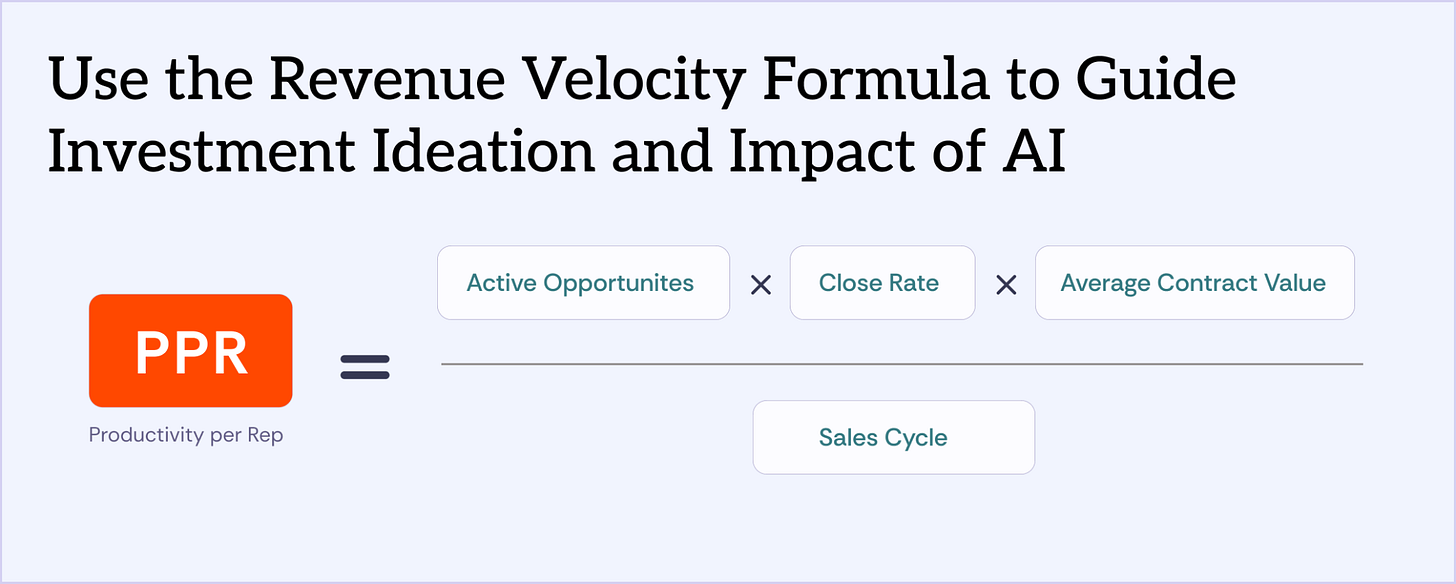
So: If we have 20 active opportunities at a 30% close rate, we expect six closes. Six closes at a $100K ACV gives us $600K. With a two-quarter sales cycle, we divide by two to arrive at $300K per quarter.
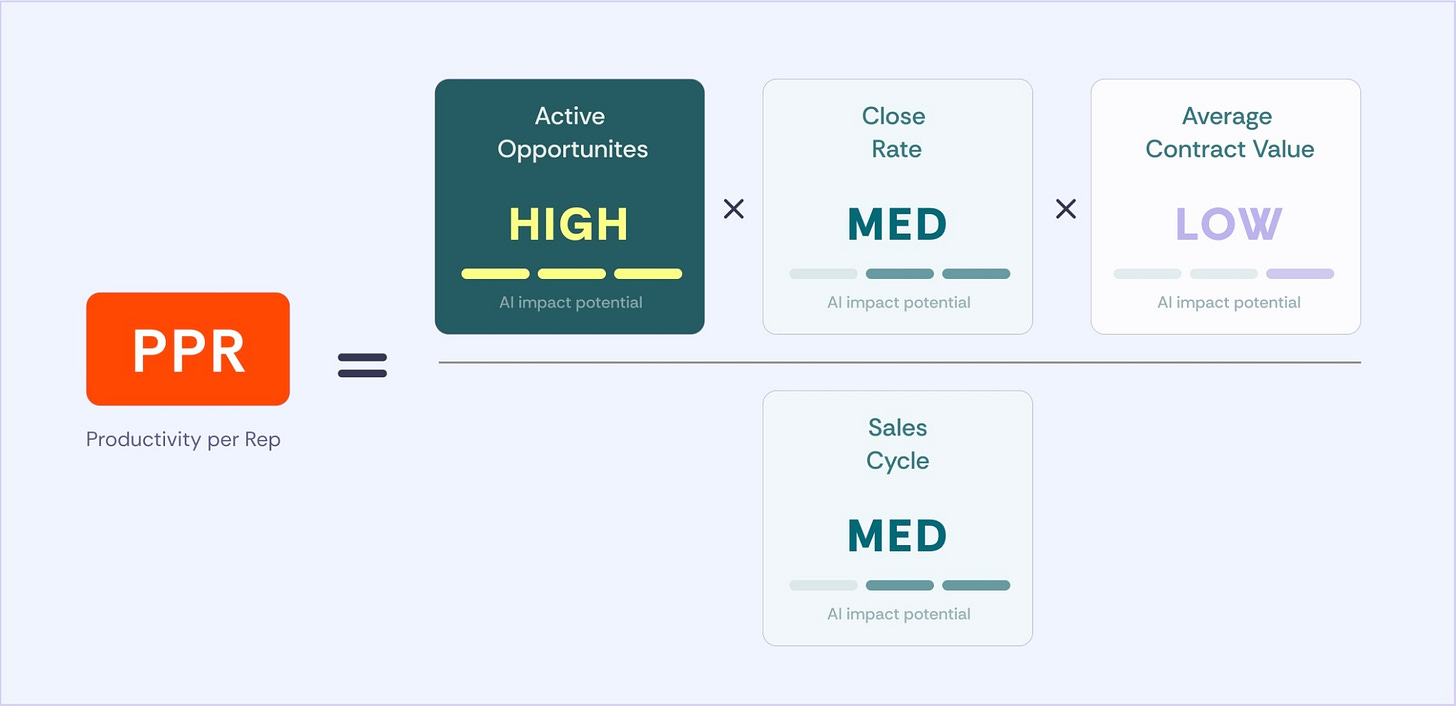
Let’s evaluate the potential impact, cost, and risk associated with each variable in the RVF.
Ironically, ACV is probably the least attractive target for AI investment. Realistically, anyone can increase prices. The challenge is maintaining product-market fit while doing so. Pricing changes typically reflect positioning strategy, packaging, or product differentiation — not AI investments within the GTM organization.
If anything, successful AI implementations should reduce customer acquisition costs, creating flexibility to pass savings to customers rather than increasing prices.
Close rate and sales cycle represent much more interesting opportunities. These capabilities should improve win rates while reducing deal cycle length.
We’re already seeing promising GTM AI use cases emerge that impact these metrics:
- AI buyer simulations for sales practice
- Real-time meeting coaching
- Post-call deal strategy agents
- Automated next-step recommendations
- Demo wireframe creation
- Sales room generation
- Skill diagnosis and corollary coaching execution
I intentionally discuss these metrics together because attribution quickly becomes difficult: Did AI improve close rates? Or did it shorten sales cycles? Ultimately, both contribute to higher PPR, so precise attribution matters less than tracking overall revenue velocity improvement.
There is, however, one important observation that limits the impact of these AI investments: Significant improvements in close rates and sales cycle still depend heavily on buyer behavior. Imagine a seller executes a flawless discovery meeting. Within five seconds of the meeting, the seller is perfectly prepared with motions produced by AI:
- A follow-up email
- A meeting summary
- An updated CRM
- A next meeting agenda
- A customized demo
- An RFP draft
- A sales room
- A mutual action plan
But the buyer still needs to evaluate competing vendors, coordinate multiple stakeholders, align budgets, and secure executive approval.
Sales teams are heavily incentivized to streamline seller workflows; buyers are too, but less so. That gap is becoming the bottleneck on ROI for these two variables:
The largest opportunity today is increasing the number of active opportunities each seller can effectively manage simultaneously. Unlike with the sales cycle, this is largely within the organization’s control.
As long as sufficient high-quality TAM exists, AI enables sellers to manage dramatically more opportunities without sacrificing execution quality. Promising use cases include:
- AI prospect identification
- Automated account research
- Personalized outbound messaging
- Meeting preparation
- Automated CRM updates
- Forecasting automation
- RFP response generation
Top-performing organizations should eventually be able to double the number of active opportunities handled by each AE by the end of 2026.
Though, of course, quality still matters. If sellers begin juggling too many opportunities without realizing the promised efficiency gains of the AI investments, warning signs will appear quickly:
- Declining close rates
- Longer sales cycles
- Slower stage conversion
- Lower LIR over time
The metrics themselves become your safeguard.
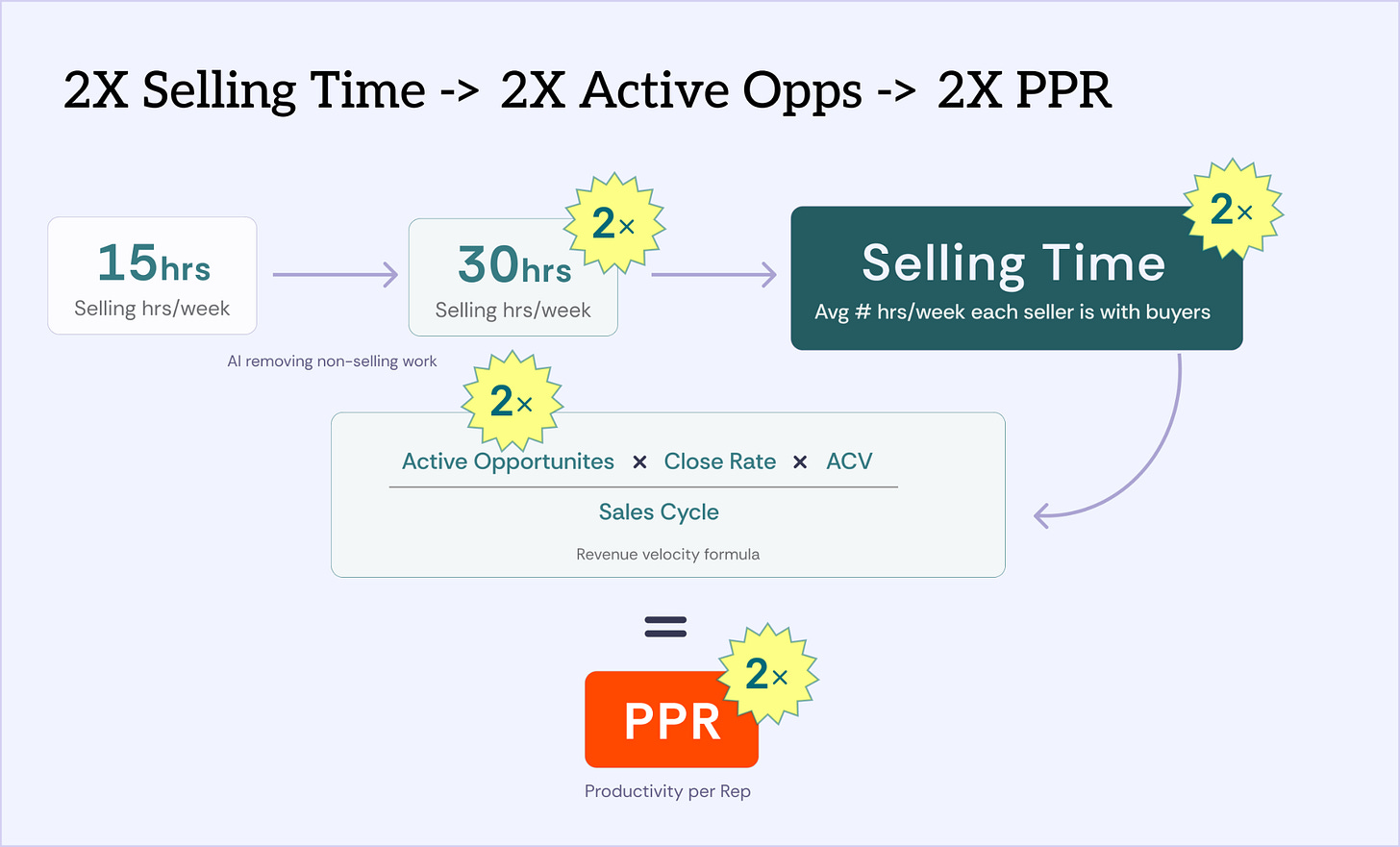
We can deconstruct active opportunities one level further. The underlying driver is “selling time” — the number of hours per week a seller spends interacting with prospects or customers.
This is perhaps the easiest way to conceptualize AI’s impact. Imagine two identical AEs: same product, same territory, same pricing, same ICP, same competitive landscape. The only difference? One spends 15 hours each week with buyers, historically the norm for best-in-class organizations. The other spends 30, within the range I believe elite sales organizations can reach with today’s AI capabilities. The latter seller can manage significantly more opportunities, create more pipeline movement, and ultimately, produce much higher PPR.
This is where today’s AI creates immediate value — not by replacing sellers, but by eliminating non-selling work.
Track:
- Outputs
- Primary: PPR
- Secondary: Percentage of AEs hitting quota
- Quality check: LIR
- Revenue Velocity Formula Inputs
- Active opportunities
- Close rate
- Average contract value
- Sales cycle
- KPI for Active Opportunities
- Selling time
Selling time used to be the hardest of these to measure accurately. Not anymore — AI makes it easier through calendar analysis, meeting intelligence platforms, CRM activity, conversation data, and other digital signals.
List every GTM AI capability or agent your organization can implement, organized by which component of the revenue velocity formula they’re expected to influence. Don’t obsess over perfect attribution. Focus instead on expected business impact, implementation effort, and execution risk — the same prioritization framework used by great product managers and RevOps teams.
Most AI initiatives require experimentation. Rather than disrupting your entire sales organization, create a pilot team. Benchmark their performance. Measure the resulting changes in revenue velocity.
Once improvements become repeatable, roll those capabilities out across the broader organization and confirm that the gains scale with the rest of the team.

Every executive team can produce a list of AI tools they’ve purchased. Far fewer can demonstrate measurable business impact.
The organizations that win won’t necessarily be those with the most AI. They’ll be the ones that connect AI investments to operational metrics, improve those metrics systematically, and ultimately produce higher PPR while maintaining customer quality and long-term retention.
That’s how AI moves from being an exciting technology initiative to becoming a durable competitive advantage.
For more first-principles GTM frameworks, check out The Science of Scaling by Mark Roberge. One-hundred percent of the book’s proceeds are donated to mental health initiatives.
Mark Roberge is the Co-Founder of Stage 2 Capital and a Senior Lecturer at Harvard Business School. He’s the founding Chief Revenue Officer at HubSpot. He has been featured in The Wall Street Journal, Forbes magazine, Inc. magazine, The Boston Globe, and Harvard Business Review. He’s also the best-selling author of The Sales Acceleration Formula and The Science of Scaling.